
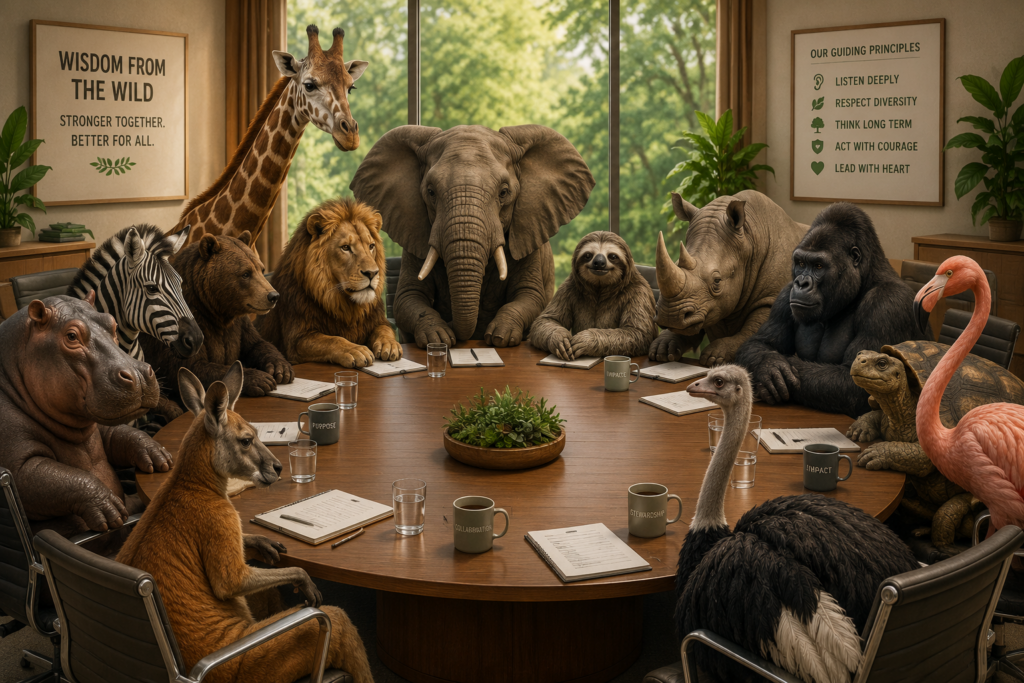
My speaker colleague Julie Henry is a leadership development professional who has made a career of applying animal behaviors and insights to help leaders grow.
She also works with nonprofit boards and I thought it would be a fun article that shows board members how to benefit from lessons from her book, Wisdom From The Wild.
Julie agreed to share her insights and to set the framework for our interview, I asked, What is the main lesson from your book, that can be applied to nonprofit boards?
She shared, “As members bring their individual expertise to the board, my book encourages them to also bring their ‘individuality’ to the board. A high-functioning board is as much about how the members interact – make decisions, participate in discussions, and provide a safe space for the staff they support – as it is about their own professional perspective.
An ecosystem is healthy and able to withstand change when the animals are all ‘doing their own thing’ and occupying the niche they are meant to occupy instead of trying to be different than they actually are.”
Thinking about the challenges boards can face and the interpersonal dynamics that sometimes cause disruption and prevent board members from working cooperatively, I couldn’t resist asking Julie, How would inhabitants in the animal kingdom work out differences in the board room–without eating each other?
She provided this excellent response to my tongue-in-cheek question. “Board members can work through differences by separating the emotions from the context or facts. The natural world is filled with competition, conflict, and struggle for survival which equals healthy and productive ecosystems. So it’s not about eliminating or avoiding that reality – more acknowledging it will occur and collectively deciding to go through those times together.”
To continue the theme of applying animal behaviors to board room interaction, I next asked Julie, Why would behaviors of animals in their natural environment, be good models for board members?
She responded by saying, “Animals are all different yet complementary – an ecosystem would not survive if every animal was the same. So a board increases its chance for success if it intentionally diversifies its members.”
Nonprofit boards are constantly being asked to deal with change and disruption being faced by the organizations they serve. With my next question I asked Julie, How does the animal kingdom deal with change and disruption that so many organizations and their nonprofit boards are facing?
She had this thoughtful response, “Change and disruption are two side of the same coin – one person will define something as ‘change’ and another person will define it as ‘disruption’. Regardless, change and disruption are naturally occurring realities in both human organizations and wild ecosystems. Animals don’t try to stop change / disruption – they adapt.”
Julie shared this bonus wisdom, “Seemingly ‘negative’ things like rain or fire are not only naturally occurring, but necessary for adaptation and evolution to occur. Rain nourishes the Earth and keeps the water cycle going – fire makes space for new growth. I challenge all nonprofit boards to reimagine their realities through the lens of gratitude and commitment to continual growth. Then ‘negative’ things can be recast into a light of possibilities and potential.”
Thank You Julie for sharing these terrific insights! Learn more about Julie on her website www.juliechenry.com
How can you apply these lessons from Julie Henry’s Wisdom From The Wild to benefit your nonprofit, association, or chamber of commerce board?