
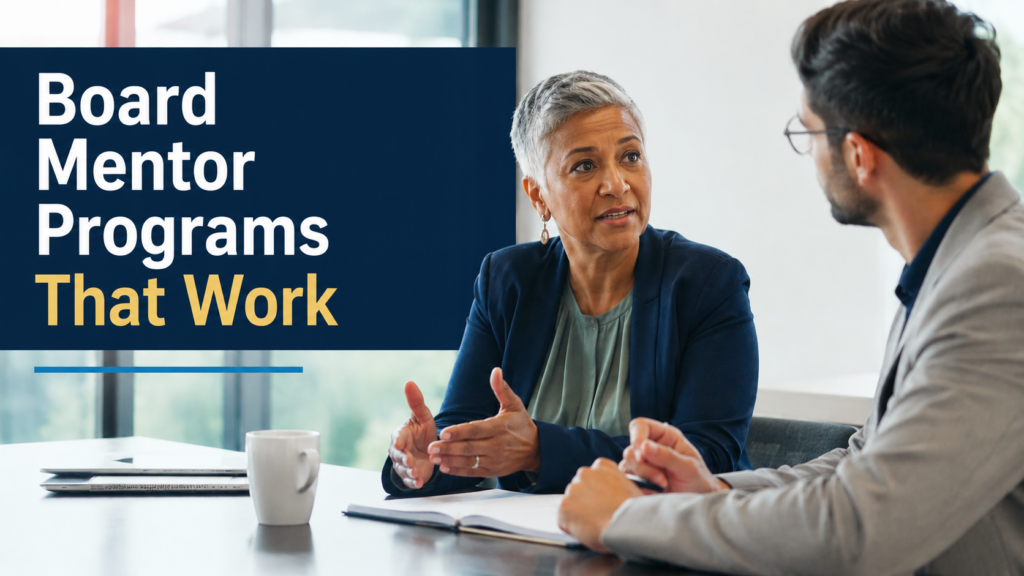
Using board mentors or board buddies can be an excellent way to get new board members engaged and to help them feel included.
To get a better understanding of what a successful mentor program would look like, I reached out speaker colleague Lisa Fain. Lisa CEO of the Center for Mentoring Excellence and is author of Bridging Differences for Better Mentoring and The Mentor’s Guide.
Lisa very graciously shared the following insights that will help a nonprofit, association, or chamber of commerce board successfully implement a mentoring program for new board members.
What is the concept of mentoring about?
To first understand what the value of mentoring is and what mentoring principles are, Lisa explained, “Mentoring is one of the most misunderstood developmental relationships.
It is a reciprocal relationship, which, at its best is not a wise person dispensing advice from on high. Rather, great mentoring is a loosely structured partnership in which mentor and mentee work together toward mutually defined goals that develop the mentee’s skills, judgment, knowledge, confidence, and perspective. Good mentoring creates space for learning, reflection, contribution, and growth on both sides.”
How can a mentoring program be beneficial for boards? How can it be especially beneficial for younger-generation new board members and new board members representing groups not previously represented on the board?
Lisa responded by addressing a familiar situation. “Have you ever been on a board where new members sit quietly on their hands, deferring to long-time board members or hesitating to offer a different point of view? It is such a missed opportunity. The board has intentionally recruited talented people, yet those very people may hold back out of uncertainty, habit, or deference. Board mentoring helps unlock that talent sooner. It supports onboarding, engagement, knowledge transfer, belonging, and contribution, while helping the board benefit from the full range of wisdom already in the room.”
What are the roles of mentor and mentee?
To clarify the roles in a mentor/mentee relationship, Lisa shared, “The mentee drives the learning. That means naming goals, asking questions, reflecting on board experiences, and taking ownership of their development. The mentor helps set the tone by building trust, creating rapport, and serving as a resource and thinking partner. Together, they co-create the relationship in a way that works for both of them.
In some organizations, a board mentor supports governance learning while a staff mentor helps orient the new board member to the operational side of the organization.
What are steps for setting up a board mentor program?
Lisa identified these steps for setting up a mentor program. “Start by articulating the purpose. Is the program focused on onboarding, leadership succession, engagement, or all three?
Then set expectations and structure. For new board members, short conversations before and after board meetings can be especially powerful. Provide resources, make thoughtful matches, create light accountability, measure what matters, and celebrate progress.
For leadership succession, the structure may look different, with more emphasis on exposure, visibility, and preparation for future roles.”
What is important to know for implementing a successful board mentor program? What are mistakes to avoid?
I have seen a mentoring program get started, only to not get the desired results.
Lisa advised these success tips will help avoid mistakes.
“There is no single recipe for a successful mentoring initiative. The structure should fit the board’s purpose, culture, and needs. The biggest mistake is treating mentoring as teaching or telling. Mentoring is about learning and contribution. Mentors should nurture the relationship, create belonging, and invite new board members to use their voice. Another mistake is assuming newer members should simply observe before they contribute. That is how boards leave insight, talent, and fresh perspective sitting unused.”
What about some final wisdom to reinforce what’s been shared?
To reinforce what she has already shared, I asked Lisa for any final nuggets she might offer and she said, “Intentionality, accountability, and buy-in from board members and executive staff are key. A board mentoring program should not be a check-the-box orientation exercise.
Done well, it becomes part of a larger learning ecosystem that helps people contribute sooner, lead more effectively, and bring more of their insight into the work of governance. The goal is not just better mentoring. It is a stronger, more engaged, more future-ready board.”
Thank You Lisa Fain for sharing your valuable insight to help implement a successful new board member mentoring program. Learn more about Lisa at her website www.CenterForMentoring.com