
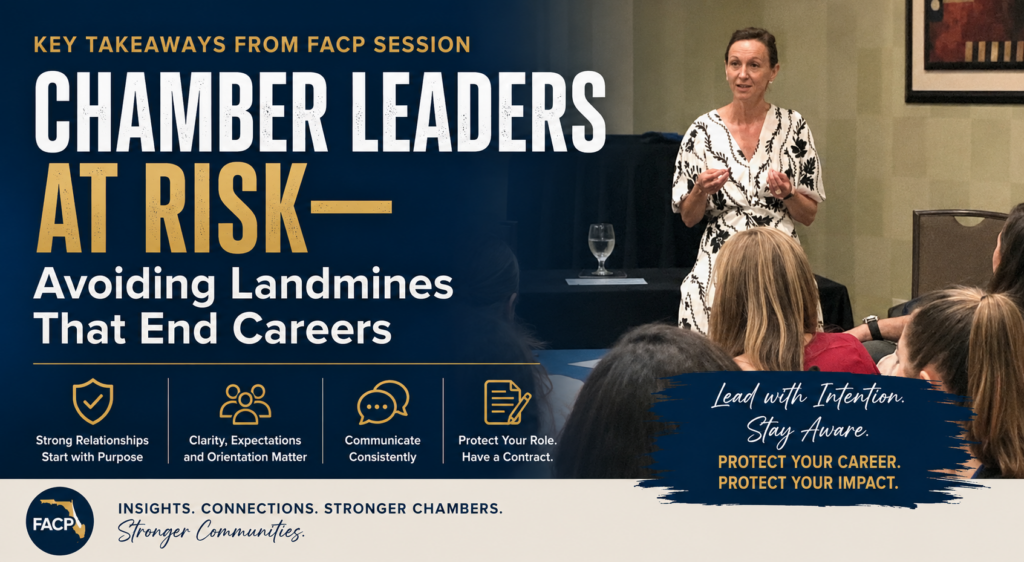
Few sessions carry the emotional weight and honest vulnerability of Chamber Leaders At Risk – Avoiding Landmines That End Careers, held during the recent Florida Association of Chamber Professionals (FACP) conference.
I teamed up with Sheree Anne Kelly, President/CEO of Association of Chamber of Commerce Executives (ACCE) to lead this safe-place conversation.
The session was based on Sheree Anne’s recent compelling ACCE Magazine article addressing the career challenge chamber leaders are facing.
A room full of chamber professionals participated in a difficult but necessary discussion about the painful reality that even high-performing chamber execs can suddenly find themselves at risk when they have ignored the warning signs until it is too late.
One of the strongest moments came when attendees were asked a simple but revealing question: “Who here is feeling a sense of career crisis?” Hands slowly rose across the room. For many, it was confirmation they were not alone. The conversation shifted from theory to lived experience as leaders shared stories of changing board dynamics, unclear expectations, broken communication, and situations where trust between executives and boards had eroded.
The discussion highlighted several red flags that chamber leaders should never dismiss.
These included sudden shifts in board behavior, inconsistent communication, lack of transparency, unrealistic expectations, and growing isolation of the CEO or president from key decision-making conversations.
Sheree Anne emphasized that many career-ending situations do not happen overnight. Instead, they develop gradually when governance practices weaken and leaders fail to recognize early warning signs.
I reinforced the importance of being proactive with board relationships and shared four priorities from my book, Stop The Nonprofit Board Blame Game, every chamber leader should embrace to create healthier board relationships.
Those priorities included:
- Recruiting board members with purpose and process.
- Establishing clear expectations.
- Providing strong orientation for new board members.
- Ensuring effective communication remains constant.
These principles may sound simple, but attendees repeatedly acknowledged how often they are overlooked.
Another compelling part of the discussion focused on employment contracts.
Sheree Anne stressed that contracts are not simply legal documents; they are tools that create clarity, protection, and mutual accountability. Many in attendance admitted they either lacked contracts entirely or had agreements that offered little real protection. The conversation prompted leaders to think differently about advocating for themselves professionally.
Perhaps the most valuable takeaway from the session was the reminder that chamber leaders cannot afford to ignore career future-proofing.
Career success is no longer based solely on performance. It also depends on governance health, relationship management, and the ability to navigate increasingly complex board dynamics.
The session closed not with fear, but with empowerment. Attendees left with practical action plans, renewed awareness, and a deeper understanding that protecting a career is not selfish — it is responsible leadership. Most importantly, they left knowing they are not alone in facing these challenges.
Thank you Tammy Bracewell and FACP for including this session in your conference.
If you are a Chamber leader who needs guidance for navigating board relationship challenges, I’m available and you can contact me at Hardy@HardySmith.com
Other Resources are: www.FACPonline.com and WWW.ACCE.com